
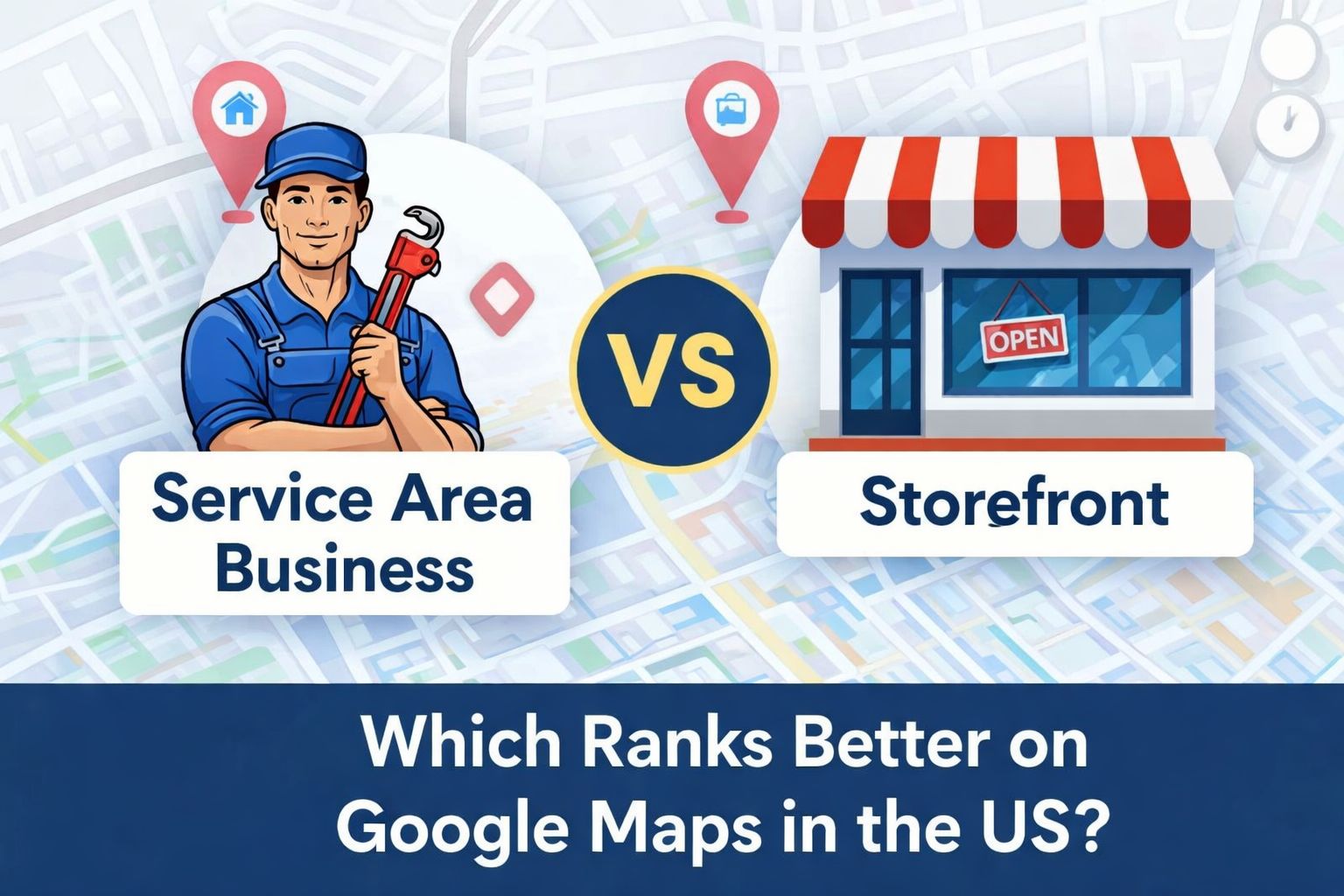
If you run a local business in the United States, one of the most important decisions when setting up your Google Business Profile (GBP) is this:
Should you choose a Service Area Business (SAB) or a Storefront location?
Many contractors, plumbers, electricians, roofers, and service providers wonder:
“Which one ranks better on Google Maps in the US?”
The answer is not black and white — but understanding the difference can significantly impact your Google Maps visibility and lead generation.
This guide explains how Service Area Businesses and Storefront businesses rank in the US — and which setup is best for your situation.
What Is a Service Area Business (SAB)?
A Service Area Business is a business that:
- Serves customers at their location
- Does not have a publicly accessible storefront
- Can hide its physical address
- Defines service areas instead of walk-in traffic
Examples in the US:
- Roofing contractors
- Plumbers
- HVAC technicians
- Electricians
- Mobile car detailers
- Cleaning services
In this setup, your address is hidden, and Google shows your business in relevant service areas based on proximity and relevance.
What Is a Storefront Business?
A Storefront business has:
- A physical location customers can visit
- A publicly visible address
- Set opening hours
- Walk-in capability
Examples:
- Retail stores
- Law offices
- Medical clinics
- Restaurants
- Repair shops
Google can verify and map this location directly, which can influence ranking strength.
Which Ranks Better on Google Maps in the US?
Here’s the short answer:
👉 Storefront businesses often have a slight ranking advantage in very competitive markets.
👉 But properly optimized Service Area Businesses can absolutely rank in the Top 3.
Let’s break it down.

1️⃣ Proximity: The Biggest Ranking Factor
Google Maps rankings are heavily influenced by:
- Relevance
- Distance
- Prominence
Distance (proximity to the searcher) is extremely powerful.
If a user searches:
“plumber near me”
Google prefers businesses physically closest to the searcher.
Storefront businesses have a fixed location, so proximity is easier for Google to calculate.
Service Area Businesses depend more heavily on:
- Service area settings
- Content relevance
- Reviews
- Engagement signals
This means SABs must be optimized more strategically.
2️⃣ Trust & Verification Signals
Storefront businesses often:
- Display a visible address
- Show storefront photos
- Have signage
- Receive foot traffic
These can create stronger trust signals in competitive metro areas like:
- New York
- Los Angeles
- Chicago
- Dallas
- Miami
However, Service Area Businesses can compensate with:
✔ Strong review volume
✔ High-quality service photos
✔ Keyword-optimized services
✔ Active posting
✔ Strong website authority
Optimization matters more than structure.
3️⃣ Service Area Business Ranking Myths
Many US contractors believe:
“Service area businesses can’t rank top 3.”
That’s false.
Google’s official guidelines allow:
- Service Area Businesses
- Multiple service areas
- Hidden addresses (if no storefront)
What matters is compliance + optimization.
If your SAB:
- Has inconsistent NAP
- Weak review profile
- Poor category selection
- Thin website content
You won’t rank — but not because you’re an SAB.
You won’t rank because of weak optimization.
4️⃣ When Storefront Is Better
A storefront setup works best when:
- You actually receive customers at the location
- You have permanent signage
- You meet Google’s guidelines
- You operate in a competitive urban area
Do NOT fake a storefront.
Google suspends businesses that:
- Use virtual offices
- Use PO boxes
- Use coworking spaces without signage
- List fake addresses
Suspensions in the US are common for non-compliant storefront setups.
5️⃣ When Service Area Business Is Better
Choose Service Area Business if:
- You work from home
- You travel to clients
- You don’t have a public office
- You operate across multiple cities
- You want privacy
For contractors, SAB is often the correct and compliant structure.
6️⃣ What Actually Determines Ranking in the US
Whether SAB or storefront, ranking depends on:
✔ Primary category accuracy
✔ Secondary categories
✔ Keyword-optimized business description
✔ Service list optimization
✔ Review quantity and velocity
✔ Website SEO
✔ Backlinks
✔ User engagement
✔ Regular posts and updates
Structure alone does not guarantee ranking.
Strategy does.
7️⃣ Multi-City Targeting: A Key Difference
Service Area Businesses sometimes try to:
- Add 20–30 cities in service areas
Google ignores most of them.
To rank in multiple cities in the US, you need:
- City-specific landing pages
- Strong internal linking
- Local relevance signals
- Backlinks tied to that city
Simply adding cities inside GBP does not guarantee ranking there.
8️⃣ Compliance Matters More Than Aggression
Google is strict in the US market.
Avoid:
❌ Fake addresses
❌ Keyword stuffing in business name
❌ Duplicate listings
❌ Spammy citations
A suspended profile can kill your lead flow overnight.
Proper structure + compliant optimization is safer long-term.
So… Which Should You Choose?
Here’s a simple decision guide:
Choose Storefront if:
- Customers physically visit you
- You meet Google’s signage requirements
- You operate in a dense metro
Choose Service Area Business if:
- You travel to clients
- You work from home
- You don’t want your address public
- You operate across service zones
For most US contractors and home service providers, Service Area Business is the correct setup.
How to Make Either Structure Rank Top 3
Regardless of structure, ranking requires:
- Full GBP optimization
- Structured review acquisition
- Localized website SEO
- Category refinement
- Engagement optimization
- Ongoing updates
This is where professional Google Business Profile optimization makes a measurable difference.
If you want to rank Top 3 on Google Maps and generate more inbound calls, explore:
👉 Google Business Profile Optimization for US Service Businesses
Frequently Asked Questions
Can a Service Area Business rank in competitive US cities?
Yes, if optimized properly with strong reviews, correct categories, and supporting website SEO.
Does hiding my address hurt ranking?
No. If you’re a legitimate service area business, hiding your address is compliant and does not automatically hurt rankings.
Can I change from Service Area to Storefront?
Yes, but you must meet Google’s eligibility guidelines. Changing incorrectly may trigger suspension.
Does Google prefer storefronts?
Not officially. Google prefers relevance, proximity, and prominence — not just structure.
Final Thoughts
Service Area Business vs Storefront is not about which one “wins.”
It’s about:
- Compliance
- Strategy
- Optimization depth
- Local authority
- Engagement
Most US service businesses fail to rank not because of structure — but because their Google Business Profile is under-optimized.
If you want predictable map visibility and high-value local leads, structure alone is not enough.
Optimization is everything.
Also Read: